



To build a base in Rust, start with a 2x1 footprint, upgrade it to stone as quickly as you can, and protect the core with an airlock and a tool cupboard placed deep inside. Keep loot in several boxes instead of one. A small base is cheap to upgrade and cheap to maintain, which matters far more in the first hours of a wipe than anything fancy.
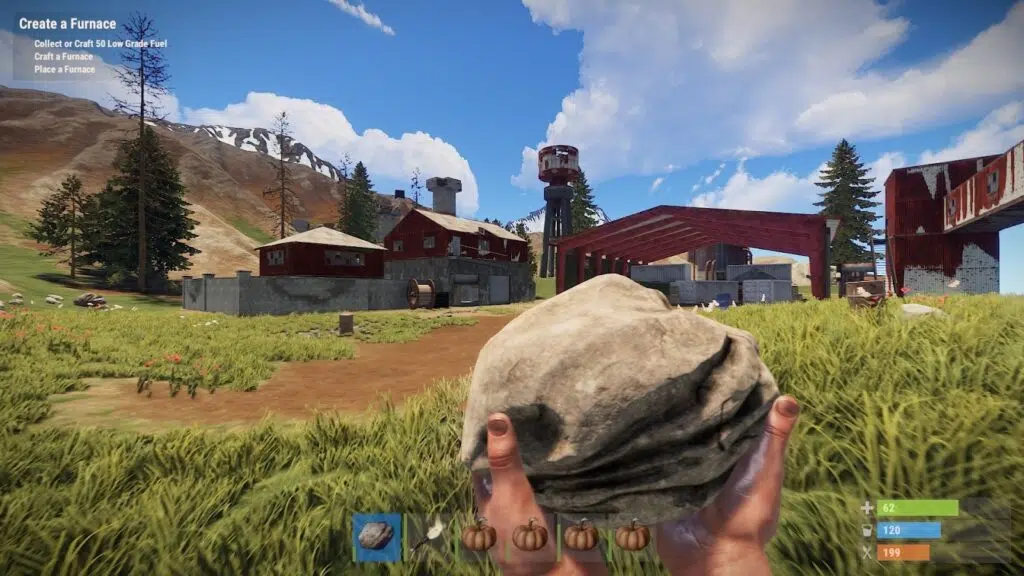
What a starter base is for
It is a small, fast structure that gives you a bed, a place to store loot and some protection. Many new players try to build big straight away, run out of materials and lose the base to decay or a raid. Start small, then expand once you have a steady supply.
Before you place anything, you need a Building Plan and a Hammer, plus a stone hatchet and pickaxe to gather. You will want wood, stone and metal fragments. Solo players and duos do best with a small base, because upkeep scales with size.
Choosing where to build
Location decides how your wipe goes. Stay out of the way of big monuments such as the Airfield or Launch Site and busy roads. Look for ground with a clear view and stone nodes nearby, flat enough that foundations sit cleanly.
- Snow: lots of stone, metal and sulphur, but the cold is harsh when you are new.
- Desert: good visibility and plenty of barrels and crates, with more player traffic.
- Temperate: balanced resources and easier survival. A sensible first choice.
Materials and the tool cupboard
The tool cupboard, or TC, controls building privilege and stops decay when stocked. It also keeps other players from building on your land. Put it somewhere raiders can't reach easily and always lock it.
The building tiers, from weakest to strongest, are twig, wood, stone, sheet metal and armoured. Twig is for placement only, so upgrade straight away. Wood falls quickly to fire. Stone is the sensible early tier. Sheet metal comes in mid-game, and armoured is for late-game defence. Keep the TC stocked with upkeep materials, because even a small stone base decays if you leave it.
Building a 2x1 in five steps
1. Foundations and walls
Place two square foundations side by side and wall the edge, leaving a frame for the door.
2. An airlock
Add a triangle foundation at the entrance, with two walls and a second door. If you open the wrong door, nobody slips in behind you.
3. The tool cupboard
Put it deep inside, behind doors and walls. A half wall with a roof tile above it adds cover.
4. Storage, furnace and bed
A 2x1 can hold a furnace, several small boxes, a sleeping bag and the TC if you arrange it well.
5. Upgrade the weak points
Move the foundations and core walls to stone first. Wooden bases are cheap to break and attract raiders.
Defence upgrades
You can't make a base unraidable. You can make it expensive and slow to raid. An airlock goes in from day one. Double doors add durability. Honeycombing, which means adding layers of cheap walls around the core, becomes worth it once you have a steady supply of stone.
Mistakes to avoid
- Leaving the TC without a lock.
- Building too big for your upkeep.
- Leaving twig walls in the base.
- Using a single door with no airlock.
- Putting furnaces next to doors where they can be stolen.
- Forgetting the roof. Players can drop in through gaps.
Next steps
If you play alone, read our solo Rust guide for farming and survival, and our list of Rust server picks for where to play. For people who want help spotting nodes and threats, the Rust cheat page describes our product. No cheat is risk free, and the status page is worth a look before you play.